Artificial intelligence (AI): a simple-to-understand guide
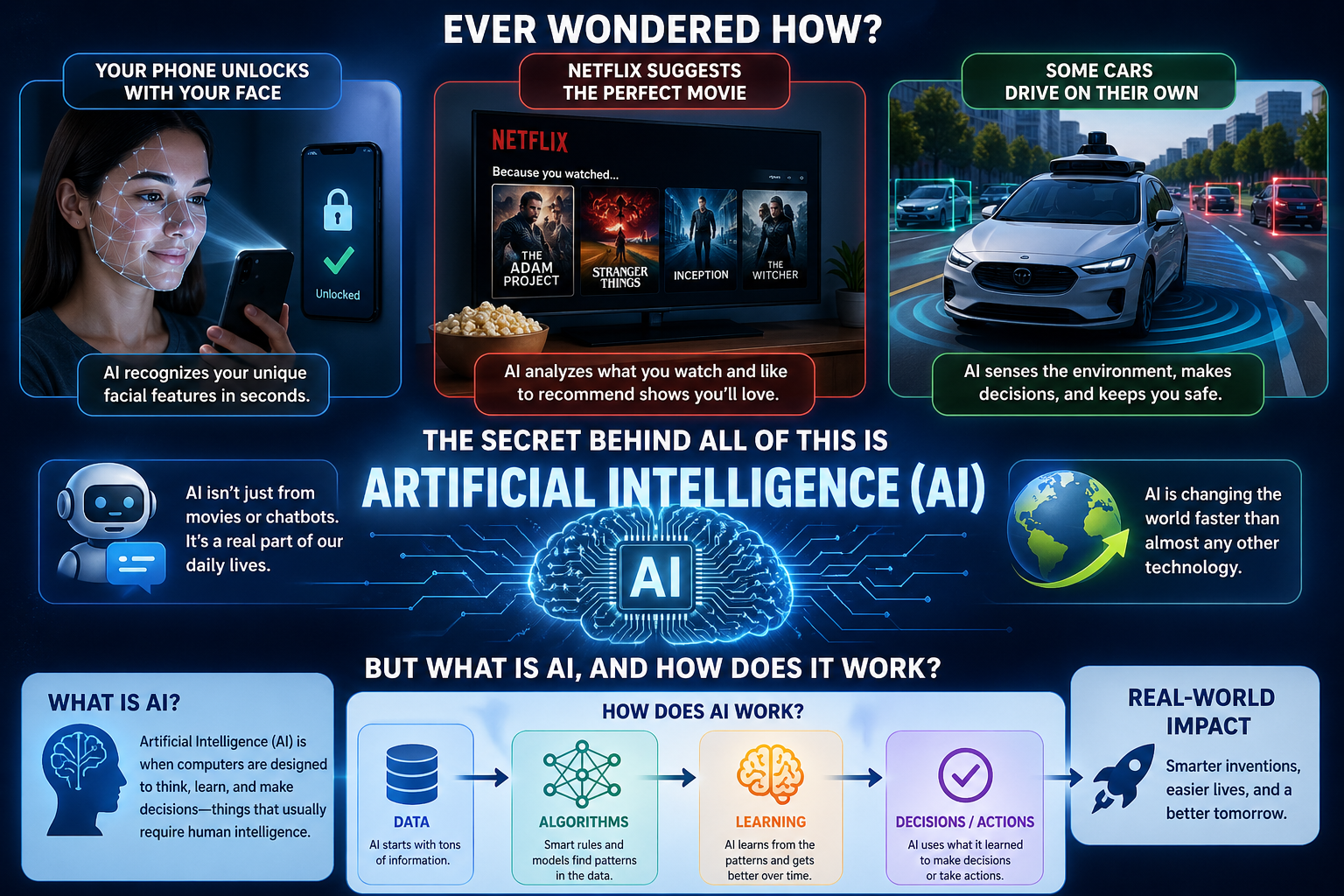
Have you ever unlocked your smartphone just by looking at the screen, followed movie recommendations on Netflix, or wondered how modern self-driving cars stay inside their lanes? The engine powering all of these experiences is Artificial Intelligence (AI).
AI is no longer just science fiction or an amusing toy. It is integrated into daily life, driving innovations faster than almost any technology before it. In this blog post, we summarize the essential concepts from the guide Artificial intelligence (AI): a simple-to-understand guide—breaking down what AI is, how it works, its core branches, common myths, and modern frontiers like Generative AI and AI agents.
What Exactly Is Artificial Intelligence?
At its foundation, Artificial Intelligence (AI) refers to a collection of technologies that allow computer systems to perform tasks that traditionally require human intelligence. These tasks include understanding speech and written language, solving problems, recognizing patterns, and offering informed recommendations.
Building effective AI draws upon multiple disciplines working together:
- Computer Science: Creates the algorithms, architectures, and running systems.
- Mathematics & Statistics: Delivers logical problem-solving frameworks and extracts insights from data.
- Neuroscience: Inspires algorithms based on the functioning of the human nervous system.
- Psychology: Analyzes human cognition, behavior, and decision-making processes.
For example, modern AI can scan an image of an invoice, extract the structured text, and categorize item costs and dates automatically, saving countless administrative hours.
How Does AI Work? The 3 Core Ingredients
Regardless of the domain or scale, every AI system relies on three foundational components:
- Data (Information): Think of data as the textbook the AI studies. Better, cleaner data leads to more accurate insights.
- Algorithms (Rules and Recipes): Systematic mathematical instructions that teach the system how to identify patterns and predict outcomes.
- High-Performance Hardware: Modern processing chips (like GPUs and cloud clusters) capable of crunching trillions of computations swiftly.
The 4 Pillars of Modern AI
AI encompasses several specialized subfields. The guide highlights four core pillars:
1. Machine Learning (ML)
Machine Learning enables computers to learn patterns directly from datasets rather than relying on rigidly hardcoded rules. For instance, if you feed an ML model thousands of bird photos, it analyzes features like beaks, wings, color palettes, and body proportions. Eventually, it learns to identify birds in new photos on its own.
2. Deep Learning (DL)
A specialized branch of ML inspired by the architecture of the human brain. Deep Learning uses artificial neural networks containing multiple hidden layers. As raw data travels through these layers, the system extracts progressively complex features. Deep Learning powers facial recognition, real-time voice transcription, and complex scientific discoveries.
3. Natural Language Processing (NLP)
NLP bridges the gap between human language and machines. It enables computers to read, analyze, interpret, translate, and generate human speech and text. NLP powers virtual assistants like Siri and Alexa, translation engines, sentiment analysis tools, and automated text generators.
4. Computer Vision
Computer Vision gives machines the ability to "see" and interpret visual inputs from cameras, images, and videos. It breaks images down into pixels, identifies objects, detects pedestrians and road signs, and assists doctors in spotting anomalies on medical scans such as X-rays and MRIs.
Categorizing AI: By Capability and Functionality
Experts categorize AI systems through two primary frameworks:
1. Classification by Capability (Brainpower)
- Artificial Narrow AI (ANI): Built for one specialized task, such as playing chess, filtering spam, or generating text. ANI does not truly "understand"; it matches statistical patterns. ANI is the only form of AI that exists today.
- Artificial General AI (AGI): A future aspiration where a computer could perform any intellectual task a human can, adapting to novel challenges without specialized training.
- Artificial Superintelligence (ASI): A theoretical state where machine intelligence surpasses the combined cognitive abilities of all humanity across every discipline, from art and logic to emotional understanding.
2. Classification by Functionality (How It Operates)
- Reactive Machines: Possess no memory of past events. They evaluate the immediate present based on predefined rules (e.g., Deep Blue playing chess).
- Limited Memory: Can retain and process historical data over short periods to refine actions (e.g., self-driving navigation systems and conversational chatbots). Most modern AI implementations fall here.
- Theory of Mind: A future research frontier where machines could comprehend human psychology, emotions, beliefs, and nuanced social cues.
Debunking Common AI Myths
Because AI evolves rapidly, several common misconceptions persist:
- Myth 1: AI is conscious and has feelings.
Reality: AI can simulate emotional responses, but it possesses no consciousness, soul, or genuine feelings. It remains a pattern recognition and prediction engine. - Myth 2: AI is inherently objective and free from bias.
Reality: AI reflects the datasets provided by human developers. If training data contains societal prejudices or historical blind spots, the model reproduces and magnifies those biases. - Myth 3: AI will replace all human jobs.
Reality: AI automates repetitive, mechanical chores. By eliminating tedious administrative overhead, it frees humans to focus on empathy, creative design, strategy, and complex problem-solving.
Key Benefits: Why AI Matters
Organizations and researchers leverage AI because it delivers tangible operational advantages:
- Accelerated Research & Discovery: In pharmaceuticals and genomics, AI predicts molecular interactions and decodes DNA sequences in days rather than decades.
- Always-On Availability: Running in cloud environments, AI works around the clock without physical fatigue, distraction, or downtime.
- Reduction of Human Error: AI executes tasks uniformly according to rigorous algorithmic specifications, minimizing mistakes in data entry, manufacturing, and auditing.
- Automated Repetitive Tasks: AI handles routine customer inquiries, data categorization, transcription, and network surveillance seamlessly.
A Brief Timeline of AI Milestones
AI's development spans several formative eras:
- 1940s–1950s: Alan Turing proposed the Turing Test to evaluate whether a computer's conversational ability could be indistinguishable from a human. In 1956, the Dartmouth Summer Research Project was held, where John McCarthy coined the term "Artificial Intelligence".
- 1960s–1970s: Early milestones arrived with chatbots like ELIZA and mobile robotics like Shakey. However, overpromising and slower-than-expected progress resulted in funding droughts known as "AI Winters".
- 1980s–2000s: The emergence of rule-based Expert Systems and statistical machine learning sparked a revival. In 1997, IBM's Deep Blue defeated world chess champion Garry Kasparov.
- 2010s–Present: Massive datasets, cloud computing power, and deep neural network breakthroughs ushered in the modern AI boom across healthcare, finance, transportation, and consumer tech.
The Cutting Edge: Generative AI, LLMs, and AI Agents
Today's AI landscape is expanding beyond passive analysis into active generation and autonomous agency:
Generative AI & Large Language Models (LLMs)
Generative AI creates novel images, writing, code, and audio based on user prompts. At the core of this revolution sit Large Language Models (LLMs), trained across vast corpuses of internet text and technical code. LLMs summarize complex documents, draft creative writing, translate languages, and increasingly process text, audio, and visual inputs simultaneously (multimodality).
The Rise of Autonomous AI Agents
While an ordinary chatbot responds to direct queries, an AI Agent operates with agency. Users provide high-level objectives, and the agent formulates a multi-step plan, interacts with tools, writes and tests software code, troubleshoots errors, and completes the workflow independently. In software engineering, agents already review pull requests, conduct automated testing suites, and organize repository codebases.
What's Next?
As AI agents become more autonomous, researchers are focused on three core priorities to ensure responsible deployment:
- Reliability: Eliminating factual hallucinations and ensuring dependable outputs.
- Efficiency: Reducing resource and compute consumption to speed up performance.
- Safety: Ensuring systems follow safety guardrails, protect private data, and align with human welfare.

